How a Dock Leveler Works
In warehouses and commercial settings, efficient and safe loading and unloading are crucial. The right equipment is key to achieving this. A dock leveler significantly simplifies and accelerates the process of transferring goods to and from vehicles, all while upholding crucial operational safety standards.
Discover how dock levelers work and how to select the best type for your operation.
Understanding Dock Levelers
Dock levelers establish a secure bridge between a building’s loading dock and the vehicles picking up or dropping off loads. They allow trucks to park with their trailers against the dock, bridging the gap and allowing hassle-free unloading with equipment like forklifts.
A dock leveler is designed to make loading and unloading quicker and easier, eliminating the need to manually lift and carry goods into the loading area. Whether you’re managing foodstuffs, clothing, building materials or other goods, a dock leveler delivers added convenience while supporting operational productivity.
How Different Dock Levelers Work
Dock levelers consist of a main surface called the deck, where teams can easily navigate to and from the delivery vehicle. The deck has two hinges, one controlling its movement at the dock and the other at the bridging lip. The lip raises and lowers to create the bridge between the loading dock and the vehicle. The deck and bridging lip can be adjusted up and down to accommodate the truck’s height.
Though they all have the same primary components, various dock levelers are powered differently. Knowing how each of them differs can help you determine the best options for your facility. Below are the various types of dock levelers and their operational principles.
Mechanical Dock Levelers
A pull chain or lever activates a mechanical dock leveler. This type has a system of strong, powerful springs that raise or lower the deck once the chain or lever is pulled. It relies on manual power, allowing you to manipulate its operation. The operator may also have to walk onto the deck to lower it correctly to the truck bed.
These dock levelers are ideal for handling low loading volumes. They are easy to use, repair and maintain and will automatically release when using air ride trailers. They are a cost-efficient way to boost productivity and safety on your loading dock.
Hydraulic Dock Levelers
These systems don’t need manual handling. Instead, they use cylinders and a hydraulic pump to lower and raise the deck. When the operator pushes a button on the control panel, the deck raises and pushes out the bridging lip, and both lower to sit level with the truck bed, simplifying unloading.
To return the deck to its original position, the operator presses the button again, and the deck and bridging lip return to their stored position. Hydraulic dock levelers are ideal for busy loading docks with high volumes, as they provide smooth and easy operation.
Air-Powered Dock Levelers
These dock levelers work with a durable airbag and compressed air to raise and lower the deck. When the raise button on the control panel is pressed and held, the airbag underneath the deck fills with air. As the deck rises and the bridging lip extends, the operator releases the button, allowing the deck to descend slowly to the truck bed.
Once loading or unloading is over, the button is pressed again, and the deck returns to the stored position. Air-powered dock levelers are energy-efficient and don’t need mechanical or hydraulic power, making them generally quieter to operate.
Vertical Storing Dock Levelers
Vertical storing dock levelers add another layer of safety, cleanliness and reliability. They’re stored upright, allowing the overhead door to lower completely. The fully closed door seals the building, protecting it from dirt, pests and intrusion. It also enhances insulation, ensuring the area maintains the right temperature and humidity.
This type of dock leveler is powered by a hydraulic system with a control panel. The operator can control the deck’s operation by pushing and holding the raise and lower buttons, increasing the system’s predictability and safety.
Edge-of-Dock Levelers
When you have limited space between the truck bed and the loading dock, edge-of-dock levelers are a space-saving option. These dock levelers are more compact than other types and can be mounted on the dock edge rather than in a pit.
They’re available in mechanical or hydraulic units. The operator uses a lever for mechanical units and pushes and holds a button for hydraulic systems. Edge-of-dock levelers maximize available space and are a cost-effective option.
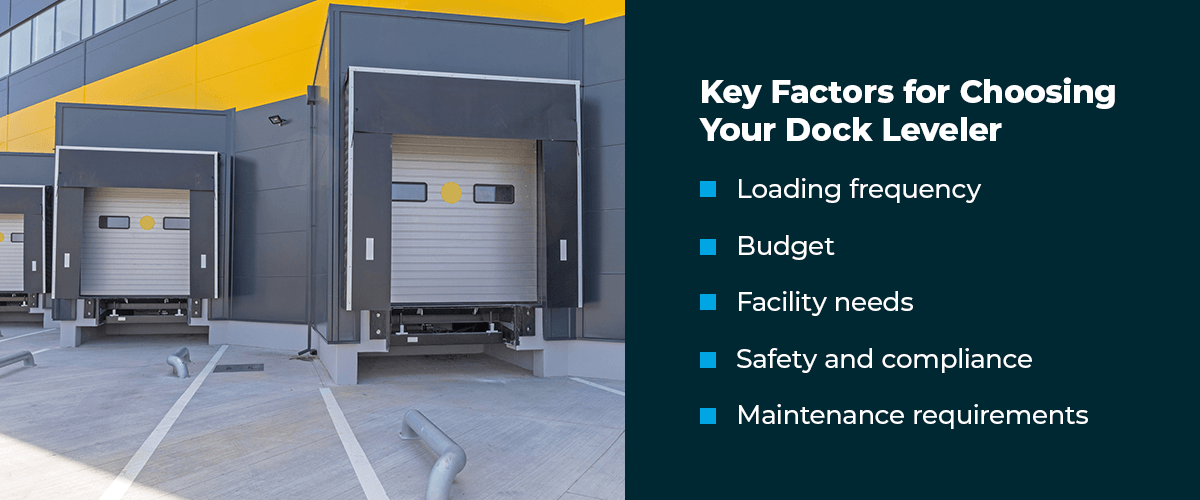
Key Factors for Choosing Your Dock Leveler
Your facility’s size, the type of goods you load and other factors all affect the type of dock leveler you need. Consider the following as you navigate between the various choices:
- Loading frequency: If you have a high-volume facility, consider a hydraulic system, which can significantly speed up operations. Mechanical and edge-of-dock levelers are best for low-volume environments. Mechanical levelers need manual power, and edge-of-dock levelers can only manage a height difference of up to a few inches between the dock and the truck bed.
- Budget: Mechanical dock levelers require a lower cost initially, whereas hydraulic systems tend to cost more upfront. Consider your facility’s plans, projected growth and expansion, and whether you’ll handle more goods in the future. Understanding your budget and long-term needs can help you determine which options are best for investing in now.
- Facility needs: Your facility type is also a significant factor. If climate control or maintaining a clean environment is crucial, vertical storing dock levelers are a good investment. However, if you manage a standard warehouse, a standard hydraulic or mechanical dock leveler can be the right choice.
- Safety and compliance: The specific compliance requirements you follow will depend on your industry, which could determine the type of dock leveler you need. These compliance regulations may include employee safety and the Occupational Safety and Health Administration’s (OSHA’s) standards. Vertical storing and hydraulic dock levelers may be the best option for industries with strict requirements.
- Maintenance requirements: Regular upkeep is key to keeping your dock leveler in peak condition. Mechanical systems can be easier and less costly to maintain than hydraulic systems. However, hydraulic dock levelers tend to offer greater speed and power.
Find the Right Dock Leveler With idcAutomatic
When managing a loading dock, choosing the right dock leveler is vital for optimal efficiency and safety. At idcAutomatic, we have trained and experienced experts who can assess your requirements and help you select the right solution.
Whether you need installation services or loading dock repairs, our team is here to help streamline your operations. Complete our online form to request your quote, and one of our experts will be in touch.