
Your Guide to LED Lighting Retrofit ROI
An LED lighting retrofit is a strategic investment that directly impacts your bottom line. For Minnesota businesses, this upgrade delivers immediate reductions in energy costs, lower maintenance expenses and access to state and utility rebates that can significantly shorten your payback period. Understanding the return on investment (ROI) of your LED lighting retrofit helps you make a data-driven decision that benefits your business for years to come.
What Is an LED Retrofit?
An LED retrofit involves upgrading your building’s existing lighting fixtures to modern, energy-efficient LED technology. This can mean replacing outdated fluorescent, high-intensity discharge (HID), or metal halide systems with new LED fixtures, or retrofitting your current fixtures with LED components that work within the existing infrastructure.
The key distinction is that an LED lighting retrofit represents a long-term investment in cutting operating expenses. This upgrade goes beyond simply changing bulbs — it transforms your facility’s energy consumption profile, improves lighting quality and reduces the ongoing burden of maintenance and replacement.
Benefits of LED Retrofits for Minnesota Businesses
LED technology has become the new lighting standard in the United States. According to the U.S. Energy Information Administration, 90% of households now use LED bulbs, with 63% using LEDs for most or all of their lighting as of 2024. The U.S. Department of Energy projects that advanced lighting systems could save 6.9 trillion kWh by 2035 if efficiency and controls targets are met — equivalent to $710 billion in avoided energy costs.
Drastically Lower Energy Bills
LEDs use significantly less wattage to produce the same light output as traditional bulbs, leading to immediate monthly savings on electricity. They can effectively replace incandescent bulbs up to 100 watts while still reducing energy consumption. This reduction translates directly to lower energy costs that appear on your very first utility bill after installation.
Reduced Maintenance and Replacement Costs
LEDs have a much longer lifespan than traditional bulbs. A quality LED bulb lasts 30 times as long as an incandescent bulb. This extended lifespan means fewer service calls, less labor spent on maintenance and reduced material costs over the life of the installation.
The financial impact becomes especially clear in facilities with high ceilings or hard-to-reach fixtures, where changing a bulb requires specialized equipment and multiple workers. Reducing the frequency of these service events from annual or semiannual to far less frequent intervals creates substantial labor savings.
Access to Significant Rebates
Minnesota utility companies and the state offer various rebates and incentives for energy-efficient upgrades. These programs can significantly reduce your initial project cost, shortening the LED retrofit payback period and improving overall return on investment.
There are several LED rebate programs for Minnesota businesses. They’re available depending on your utility provider or location, as shown in the following:
- Minnesota Power provides business incentives for LED upgrades.
- The Minnesota Center for Energy and Environment coordinates additional lighting rebate opportunities.
Working with an experienced contractor who understands these programs ensures you capture all available incentives and complete the necessary documentation for approval.
Improved Safety and Productivity
Better, more consistent lighting improves workplace safety and employee productivity, which adds financial value. LEDs provide instant-on illumination without the warmup period required by HID lamps, and they deliver consistent color rendering and reduced flicker compared to fluorescent systems.
Studies on LED warehouse lighting show that improved lighting in warehouses and industrial facilities reduces accidents, improves accuracy in picking and packing operations and contributes to better employee morale. While these benefits are harder to quantify than direct energy savings, they represent real value in operational efficiency.
How to Calculate Your LED Retrofit Payback Period
Understanding how to calculate LED retrofit payback helps you evaluate the financial merit of the investment using your facility’s actual operating costs and electricity rates.
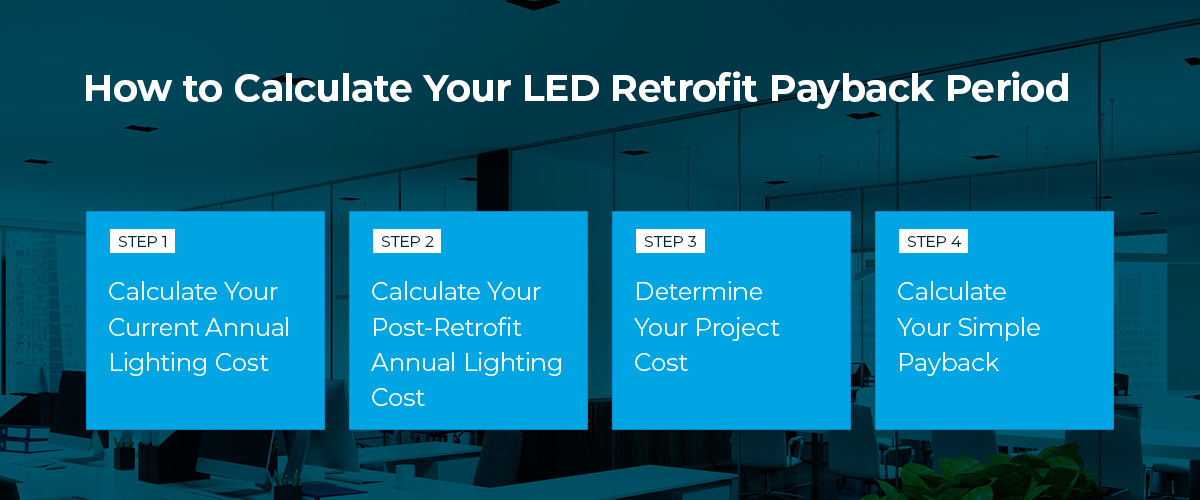
Step 1: Calculate Your Current Annual Lighting Cost
Start by determining what you currently spend on lighting electricity each year with the following:
- Your current system wattage: (number of fixtures × watts per fixture) ÷ 1,000
- Your current annual energy costs: kW × annual hours of operation × cost per kWh in Minnesota
Minnesota’s average commercial electricity rate varies by utility provider and usage tier, so use the rate from your most recent bill for accuracy.
Step 2: Calculate Your Post-Retrofit Annual Lighting Cost
Next, calculate the cost of your lighting after the LED upgrade. You can do the calculation with the following two equations:
- New system wattage: (number of fixtures × new LED watts per fixture) ÷ 1,000 = new kilowatts (kW)
- New annual cost: kW × annual hours of operation × cost per kWh = new annual cost
The difference between your current and new annual costs is your annual savings.
Step 3: Determine Your Project Cost
You will now need to factor in all up-front expenses, such as fixtures and labor, and then subtract the dollar value for available incentives. Your contractor should provide a detailed quote that includes equipment and installation labor. Apply for all relevant Minnesota LED lighting rebates to reduce this final number.
Step 4: Calculate Your Simple Payback
Finally, you can determine how long it will take to recover your investment by dividing the total project cost by the annual savings. There’s no standard payback time for commercial LED retrofits, as it depends on current fixture types, operating hours and local electricity rates. However, it should be lower than what it costs you for your current system, thanks to reduced overall maintenance and replacement costs.
For example, say a warehouse has 100 metal halide fixtures, each consuming 400 watts and operating 12 hours per day.
Before retrofit:
- 40 kW load
- 4,380 operating hours annually
- $0.12/kWh
- Annual cost of $21,024
After retrofit:
- 15 kW load
- Same operating hours
- Annual cost of $7,884
Savings from retrofit:
Annual savings: $13,140
Project cost: $25,000
Available rebates: $5,000
Net cost: $20,000
Payback: 1.5 years
The Retrofit Process
A successful LED retrofit follows a structured approach that ensures you get the right solution for your specific needs.
- Site assessment and consultation: A qualified electrician evaluates your current lighting system, discusses your goals for energy efficiency and visibility, and identifies the best retrofit solution for your space. This assessment often includes comparing the ROI of LED high-bay vs. linear fixtures to determine which configuration delivers the best return.
- Rebate and incentive management: Your contractor helps you identify and apply for all available Minnesota-specific rebates to maximize your savings. This includes gathering required documentation, completing utility company forms and ensuring your project meets program specifications.
- Professional installation: Licensed electricians perform the installation work safely and efficiently, ensuring compliance with all local electrical codes. The installation timeline depends on facility size and complexity, but most commercial retrofits can be completed with minimal disruption to daily operations.
Frequently Asked Questions
Common questions about LED retrofit investments and implementation include:
What’s the Difference Between a Retrofit and a Full Replacement?
A retrofit modifies your existing fixtures with LED components, which can be more cost-effective when your current housings and mounting hardware are in good condition. Full replacement involves installing entirely new LED fixtures and may be the better choice for very old systems, for achieving specific aesthetic goals, or when existing fixtures are incompatible with retrofit kits. A professional can help you determine which approach delivers the best value for your situation.
Can I Install the New Lights Myself?
Commercial electrical work requires a licensed professional to ensure safety, code compliance and eligibility for utility rebates. Most rebate programs specifically require installation by a licensed contractor to qualify for incentives. Working with a professional also protects your investment through proper fixture selection, correct wiring and warranty coverage on both equipment and labor.
Start Your LED Retrofit and Reduce Your Operating Costs
An LED retrofit is a proven strategy for reducing operating expenses and improving financial performance. When you’re ready to move forward with an LED lighting retrofit, idcAutomatic can guide you through the entire process — from site assessment and rebate management to professional installation. We pull required permits, coordinate inspections and ensure compliance with all local codes, so you can focus on running your business while we handle the technical details.
Contact us today to request a quote for your project.